
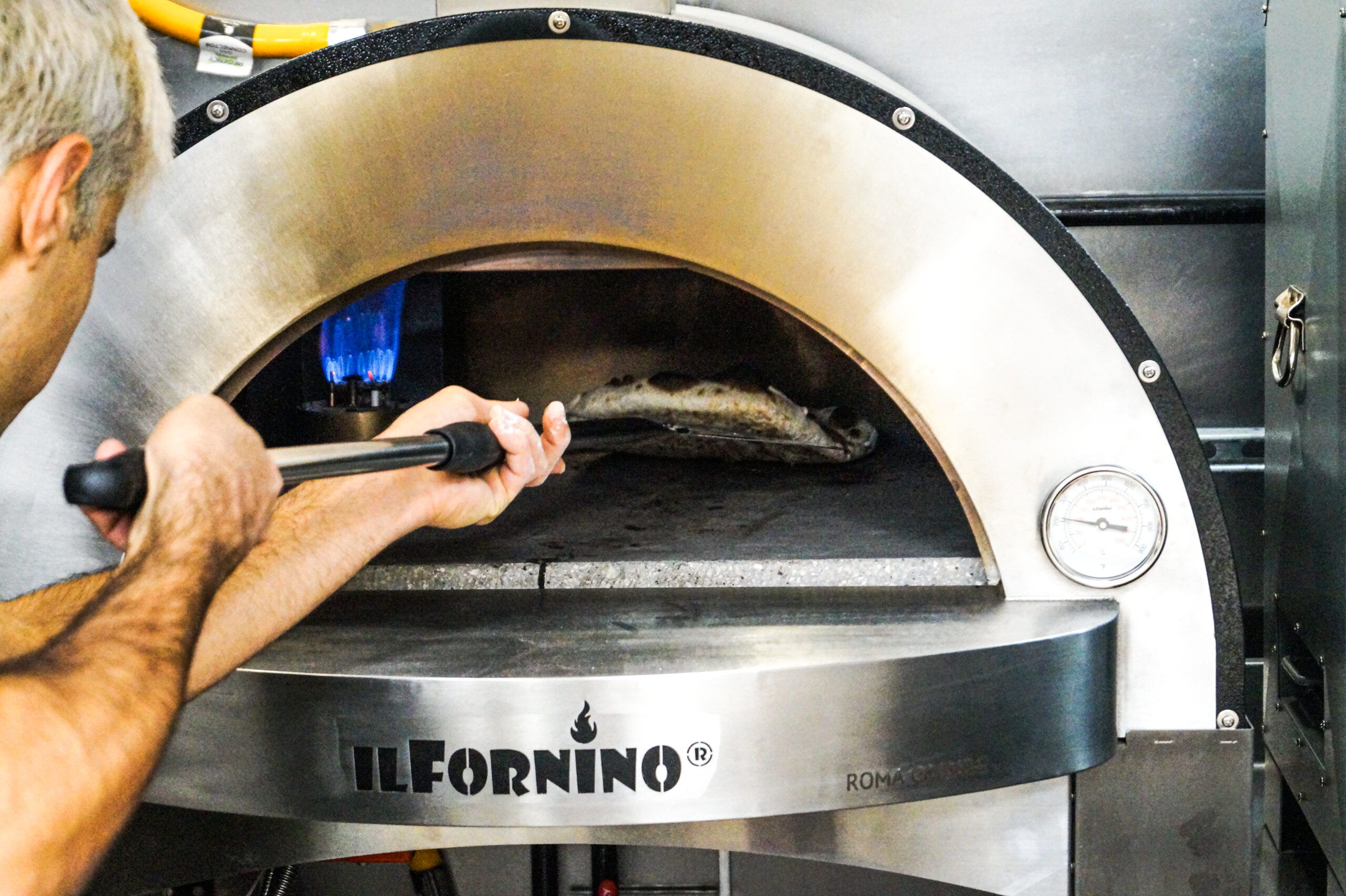
Some are born to be chefs; others discover suddenly that they have been in kitchens their entire life. “Cooking for me just came out of nowhere. I just woke up one day with this urge to cook,” says Michael Patlazhan, who is now spending his weekdays working busily by himself in a ghost kitchen on Ingraham Street. It’s his first semi-permanent, semi-brick and mortar, fittingly called “Whim.” The letters, in minimal, thin font, appear like a sudden advertisement for a watch, amid thin white and black lines. On a whim, he’s now baking pizzas. In fact, he’s baking some of the better, more adventurous pies you will find on that corner of mid-scale dives and smoldering dreams.
It had taken Patlazhan a while to get there; a Russian immigrant who moved to Brooklyn at the age of ten, he grew up in Sheepshead Bay, and eventually found himself deep in the trenches at Bloomberg (“I just did what most people do when they don’t know what to do, I went to business school,” he says now about his Brooklyn College business degree), when he decided to start taking classes, instead, at the private French Culinary Institute, back when it existed, back when it was in SoHo, when it was that breeding ground for a particular kind of manicured, small plate, urbane perfectionism. While his wife had stuck around working the Bloomberg terminals (the pair live in Staten Island now), Patlazhan’s culinary years had been tumultuous; line cook gigs at shuttered Park Avenue eateries, an episode-length stint on Top Chef, after the Bravo show had plucked him from relative culinary school obscurity. “I think the challenge was a corn soup,” Patlazhan says now, before admitting “I don’t think TV is for me, that’s what I found out.” In the years since, he would take jobs doing what he calls “high level” catering, amid running his share of pop-ups too, in the cramped cafes of nearby galleries, where he would dutifully craft potato-skin ice cream and buttermilk dots dipped in liquid nitrogen, and where Patlazhan told me the rent was hardly worth the minimal foot traffic.
Opportunity finally came his way when he reconnected with Arseny Libon, a friend from high school who speaks in a deep, gregarious New York accent. Libon had also dipped, over a decade ago, out of the working with computers and into the idea of selling somewhat higher art. Along with a few friends, Libon was involved in running an outfit called the Bottleneck Gallery, a Williamsburg group that had managed to find a decent living out of shipping what Libon called “alternate movie posters,” and other kinds of legally licensed geek material to dormrooms around the world. (“All licensed, original work,” says Libon.)