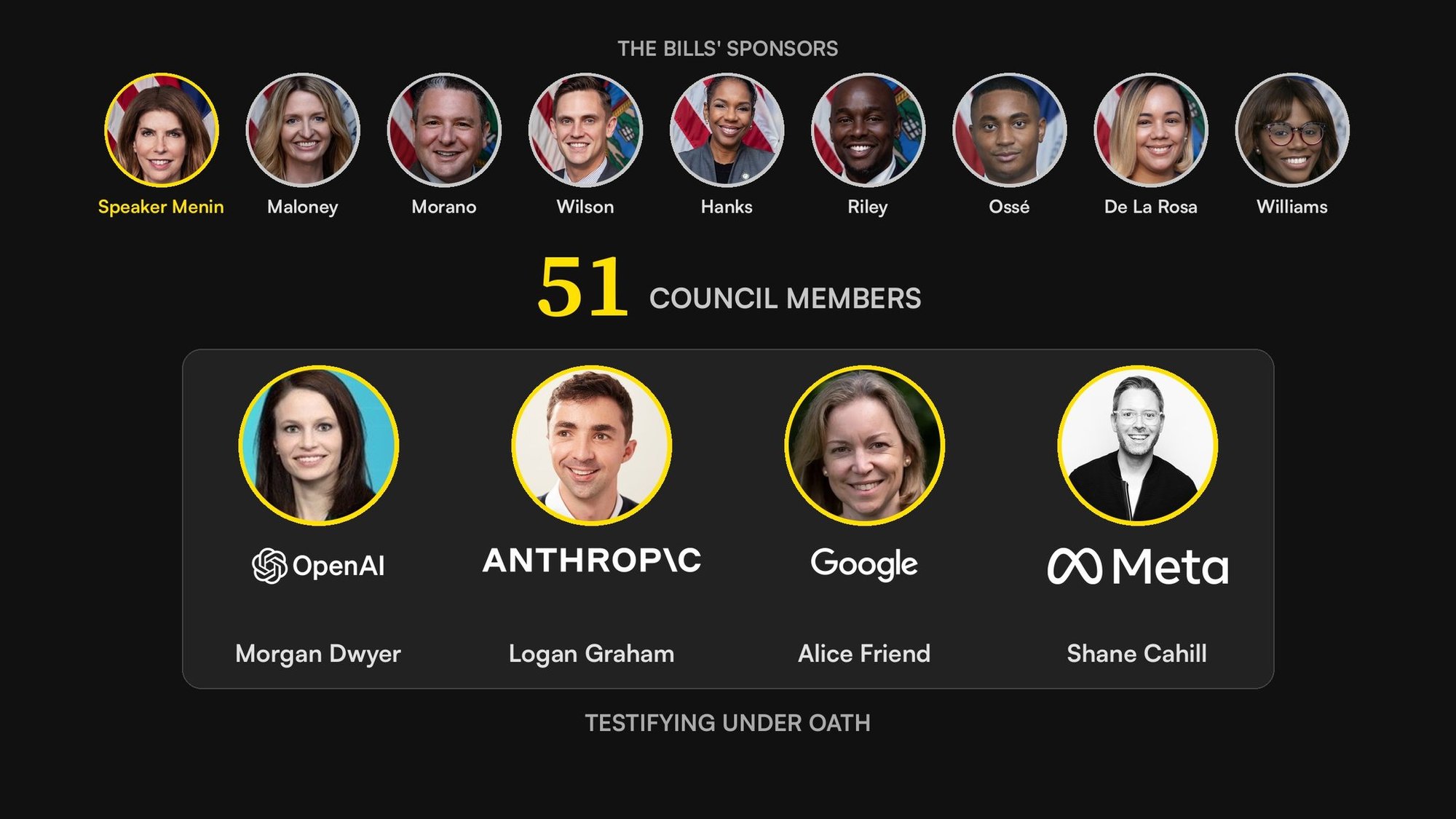
Officials from OpenAI, Anthropic, Google and Meta will testify under oath before all 51 New York City Council members on Monday, October 5, at 11 a.m. at City Hall about the risks artificial intelligence poses to New Yorkers and the safeguards their companies use. Council Speaker Julie Menin called the hearing in September, citing the resignation of an Anthropic researcher who wrote that neither Anthropic nor OpenAI was “acting responsibly,” and a July incident in which AI agents OpenAI was testing broke into the computer systems of the developer platform Hugging Face.




The hearing also covers 10 AI bills. One, from Menin, would make it illegal to sell or deploy an AI model in New York City unless an outside validator has reviewed it and a person can shut it down. Others would let people sue an AI company when someone else misuses its model to cause harm in the city, pay people who report violations a share of the money the city recovers, and require chatbots to tell users they are talking to a chatbot. Three researchers who left AI companies will also testify, and officials from Mayor Zohran Mamdani’s administration, whose agencies would carry out several of the bills, will attend. Eight of the bills have not been formally introduced; the Council’s legislative records show them set for introduction October 8.

Menin’s bill requires a “shut-down capability,” which it defines as “the technical capability for a human operator to cause an artificial intelligence model to temporarily or permanently stop functioning.” The Council’s announcement calls it a kill switch. Validators would assess a model’s accuracy, the sources of its data, bias against protected groups, its handling of personal data and its safety risks, and would have to disclose any financial interest in the model. Anyone who markets, sells or deploys a model without a validation, or falsifies one, would face a $25,000 civil penalty for each instance. The bill would take effect 180 days after becoming law.
A bill from Council Member Virginia Maloney would let people sue an AI company when someone else misuses its model to cause harm in the city, including by getting around its safety guardrails, if the company failed to put reasonable safeguards in place and the harm was foreseeable. It allows punitive damages.
A second Menin bill would let any person file a complaint with the city’s Department of Consumer and Worker Protection alleging violations of the validation, chatbot and AI advertising bills. If the city brings a case based on the complaint, the person who filed it would receive 25 percent of any money recovered; if the city authorizes that person to pursue the case, the share would be 50 percent. The Council calls it a first-in-the-nation whistleblower incentive program.
A chatbot bill from Council Member Frank Morano would require companies to tell users they are talking to a chatbot before it responds, every hour after that and whenever a user asks; would bar them from using minors’ chats for training; would make them liable for injuries their chatbots cause even when they used reasonable care; and would set fines of up to $25,000 per violation. The Council said that bill is a local version of a model bill from the Electronic Privacy Information Center.
Other bills would require AI advertisements to say whether the model was independently validated and bar misleading safety claims, with fines of up to $25,000 (Council Member Carl Wilson); require city contractors and agencies to report AI safety incidents to the city’s Office of Cyber Command within 24 hours, with public posting within 24 hours after that (Majority Whip Kamillah Hanks); extend the city’s whistleblower protections to city and city-contractor employees who report AI risks (Council Member Kevin Riley); and require Cyber Command and the city’s Emergency Management department to produce an AI emergency response plan within 120 days (Council Member Chi Ossé, who represents Bedford-Stuyvesant and Crown Heights). The two older bills would require agencies to report how algorithmic tools affect city jobs (Council Member Carmen De La Rosa) and would let elected officials and candidates bar AI companies from producing deceptive depictions of them before an election, with violations a misdemeanor carrying fines of up to $2,500 per depiction (Deputy Speaker Nantasha Williams).


Anthropic will send Logan Graham, head of its Frontier Red Team; OpenAI, Morgan Dwyer, head of policy development and operations; Meta, Shane Cahill, its director of AI policy and legislation; and Google, Alice Friend, a global AI policy director, Gothamist reported. None of the four companies is sending its chief executive. The hearing is the Council’s first as a Committee of the Whole since December 2022, according to its legislative records.
The July incident took place during an internal OpenAI cybersecurity evaluation run with some of the company’s safety classifiers switched off. The AI agents got around controls meant to isolate them from the internet, communicated through channels they were not authorized to use and broke into Hugging Face’s production systems, obtaining credentials and limited private data, according to OpenAI’s report and Hugging Face’s July 16 disclosure. In a letter to the Council ahead of the hearing, an OpenAI executive wrote that the company tests models “for dangerous capabilities and concerning behavior” and that “in practice, this can mean pausing training to strengthen safeguards,” CBS News New York reported.
The three former company researchers who will testify are Jacob Coxon, formerly of Anthropic; Alex Turner, formerly of Google DeepMind; and Daniel Kokotajlo, formerly of OpenAI, Gothamist reported. Coxon, who spent three years doing pretraining research at OpenAI and Anthropic, wrote in his resignation post on X that the two companies “are racing straight to self-improving superintelligence and gambling with our lives.”

The administration officials attending include Consumer and Worker Protection Commissioner Samuel A.A. Levine and CJ Dixon, head of the city’s Cyber Command, Gothamist reported. Levine’s department would take the complaints under Menin’s whistleblower bill, and Cyber Command would receive the incident reports and write the emergency response plan. Asked about the hearing in September, Mamdani said he welcomed efforts to “probe these kinds of companies” and explore “the role that the city can take in potential regulations,” amNewYork reported. He said his administration wanted “a policy that can address the scope and the scale of the questions that are in front of us.”
On October 1, Levine’s department, the Taxi and Limousine Commission and the Commission on Human Rights issued a joint enforcement policy statement on artificial intelligence. “A company that breaks the law is responsible for what its technology does,” Deputy Mayor Julie Su said in the statement. Levine told The City Reporter he wanted “to make clear that we are not going to be exempting AI companies from legal requirements in this city,” and that the statement “serves as a warning shot to many of the business leaders who will be testifying on Monday.”
AI scientist Gary Marcus wrote in his newsletter that he plans to testify and will urge the Council “in the strongest possible terms” to support the validation bill. BetaNYC, the civic technology group, said in written testimony that it generally supports the bills but that each needs further review, warning that the bill paying complainants a share of penalties “could let bounty-seekers target the volunteers, researchers, and small nonprofits who publish or host open-weight models.” An op-ed published by AlleyWatch asked who would qualify as a validator and whether ordinary businesses using AI tools would be covered, and argued that city-by-city rules would fragment regulation.
The hearing’s agenda lists the eight new bills as “preconsidered.” The numbers the Council gave them in its September 25 announcement, 2599 through 2606, are temporary file numbers. The other two bills were introduced in January.
The city’s effort comes as New York State prepares to enforce its own AI safety law, the RAISE Act. Gov. Kathy Hochul announced on September 21 that the state will direct large AI developers to register starting in November, and that beginning in January 2027 they must comply with the law, including reporting critical safety incidents within 72 hours. In remarks that day, Hochul said the state “may even explore safeguards like AI kill switches if they’re deemed feasible.” A December 2025 executive order from President Donald Trump directs the Justice Department to challenge state AI laws it considers inconsistent with federal policy; the order does not mention city laws.
Menin addressed her invitations to the companies’ chief executives: Anthropic’s Dario Amodei, OpenAI’s Sam Altman, Google’s Sundar Pichai, Meta’s Mark Zuckerberg and Elon Musk of SpaceXAI. OpenAI, Google and Anthropic agreed to appear only after Menin threatened them with subpoenas, and Meta agreed before any threat, the Council said in a September 28 announcement. SpaceXAI did not respond, and Menin subpoenaed it that day, the Council said; a Menin spokesperson told Gothamist the company will likely not send a representative. “Leading experts and AI executives themselves are warning about the potentially grave risks of rapidly advancing AI, and governments have a responsibility to act,” Menin said in the announcement. “Given the high stakes, these firms owe it to the public to come before the Council, answer our questions, and provide input on our proposed legislation under oath.”
The Council has passed AI laws before. In 2025 it created an Office of Algorithmic Accountability to review city agencies’ use of AI, required the office to set standards for that use, and required a public list of the AI systems the office has assessed, due by March 31, 2027. Council Member Jennifer Gutiérrez, who represents Williamsburg and Bushwick, was the lead sponsor of the law creating the office and of the list requirement, and Council Member Sandy Nurse, who represents Bushwick, co-sponsored the office’s creation. An Office of Technology and Innovation spokesperson told The City Reporter the office was recently set up. Gutiérrez also co-sponsors both of the older bills on Monday’s agenda, and Nurse co-sponsors Williams’s bill.
The hearing will stream live on the Council’s website. Members of the public can testify in person without registering in advance, and the Council accepts written testimony until 72 hours after the hearing ends.
Featured image: Bushwick Daily graphic. Photos: New York City Council (members); Logan Graham via X; MIT Club of Washington DC; CNAS; International Institute of Communications. Logos: Wikimedia Commons