
Text by Sarah Hassan
Photos by Katarina Hybenova
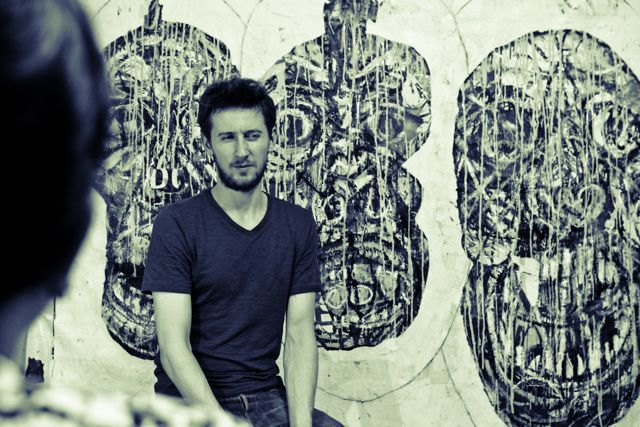
Nate Anspaugh doesn’t like to talk about himself. Blame it on his midwestern upbringing; He was born in Dayton, Ohio, and grew up with a set of traditional values that did not lend themselves to breeding self-indulgent conversationalists. Lucky for him, his current body of work generously comprised of mixed media and found objects, speaks volumes. With a gentle manner and careful way he chooses his words, Anspaugh is an understated cabinet of curiosities, from the open spaces he knew as a child, to the fury and mania of New York City, where he now resides amidst the blossoming industrial landscape of Bushwick.
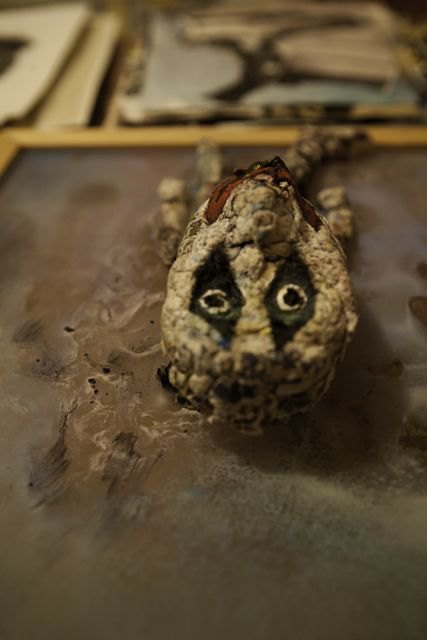
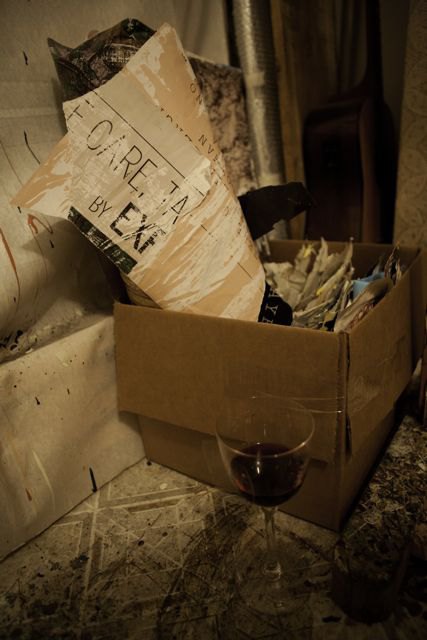
Like so many of the young and hungry artist-cum-transplants living in the city, thirty year-old Anspaugh has a lot to say on his family, influences, aspirations and fears. Yet whether waxing philosophic on consumer culture or admitting his hatred for the smell of latex, Anspaugh is just as warm and generous as you might imagine someone fresh from the Midwest to be. But don’t let the quiet reserve fool you; there is a fierce and hotly energetic quality to his work that recalls de Kooning, Twombly, Rauschenberg, and most of all, Basquiat, artists whose influences he candidly owns up to. Surrounded by his works-in-progress and finished pieces, I sat down with Anspaugh in his home studio and spoke about what drives him as an artist, how New York City has served his creative process, and of his upcoming residency in Berlin.
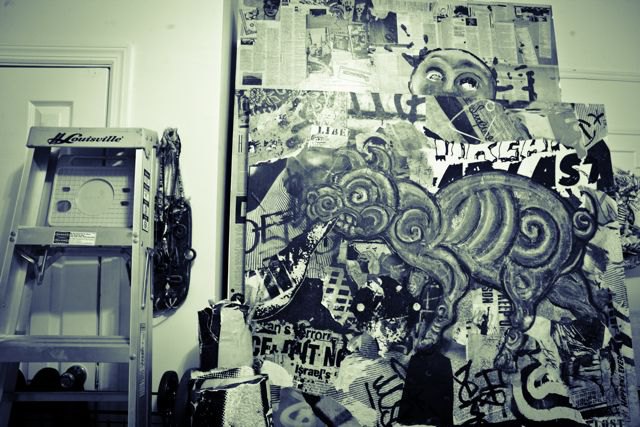
Though attracted to art at a young age – his great-grandmother and mother were both artists – Anspaugh claims music as an early love, rock n’ roll on par with colored pencils and pastels handed to him by teachers all-too aware of his visual talents. Staples of suburban life were The Rolling Stones and Aerosmith, the latter a band which, when seen live, hit Anspaugh in the gut; “I had a profound sense of ‘this is how I want to present myself,’ to connect with people in that way,” he explained. Serving some time in a music band, the experience eventually led Anspaugh back to art. He attended college at the University of Central Florida, which he admitted was a mainly a geographic desire to distance himself from home. “I did have that yearning,” he said astride a stool in his studio, “and I still do, of not wanting to stay put, and it is so hard for me because I want to move on. I struggle with the idea that ‘this can’t be all there is.’ These anxieties were aggravated by Anspaugh’s move to New York City, a place he has never felt truly settled, but nonetheless understands its crucial nature for the life of an artist.