

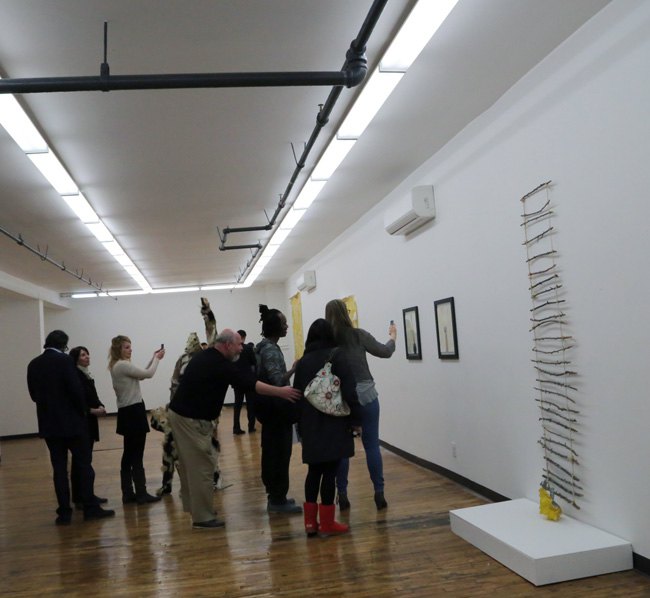
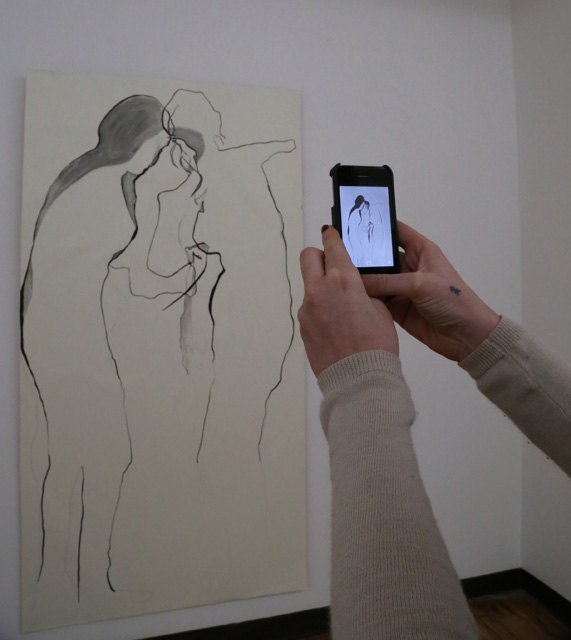
The first thing that caught my eye as I entered Twice Removed , the multimedia exhibition at the Active Space, was a group of people aiming their smartphones at sculptures and drawings along the gallery walls. It is hardly uncommon to see gallery visitors targeting artworks as their next hot tweet these days, but using a smartphone as a conduit for viewing the artwork is more unusual. As a prerequisite for having the full experience of viewing the show, the Bushwick-based artist, Lauren Carly Shaw, handed visitors flyers that provided directions for downloading an app meant to heighten the viewer’s experience. Guiding me through the show, Shaw stopped in front of a large-scale figure drawing and extended her hands forward, trying to find the best angle for the app to recognize the object in order to trigger the animation. The tiny smartphone screen promptly showed how the gestural lines, drawn with graphite, charcoal and ink, grew into an outline of two human figures.
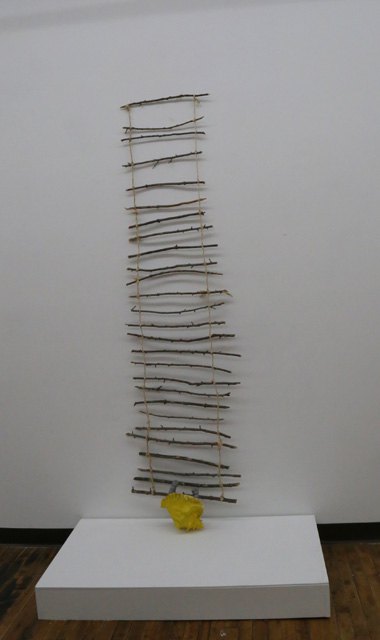
Similarly, when Shaw targeted a ladder-like row of twigs hanging on a wall with small doll parts at the bottom, her screen showed the toy moving up the ladder in wobbly steps. This sequence, like the rest of the animations in the show, is lighthearted. “I like the animation to bring a sense of fun to the pieces,” she acknowledged.
Shaw revealed a darker side in the psychologically charged White Girl Problems, the most compelling sculpture in the show. Placed directly on the hardwood floor close to a wall, this sculpture made of cardboard, wood and a lot of fake blond hair represents a female figure curled up in a horizontal fetal position. The artist explained that she wanted to convey the space we seek out during strife; a place to retreat within ourselves. “In addition to the sculpture’s physically compromising position, she has another wall around herself, the exaggeration of her hair engulfing her is a clear place to hide in plain sight,” she elaborated. Stephen Dunn’s poem, Corners which inspired the piece, says it best, “And always the thin line between corner and cornered / the good corners of bodies and those sever bodies / that permit no repose / the places we retreat to / the places we can’t bear / to be found.”