
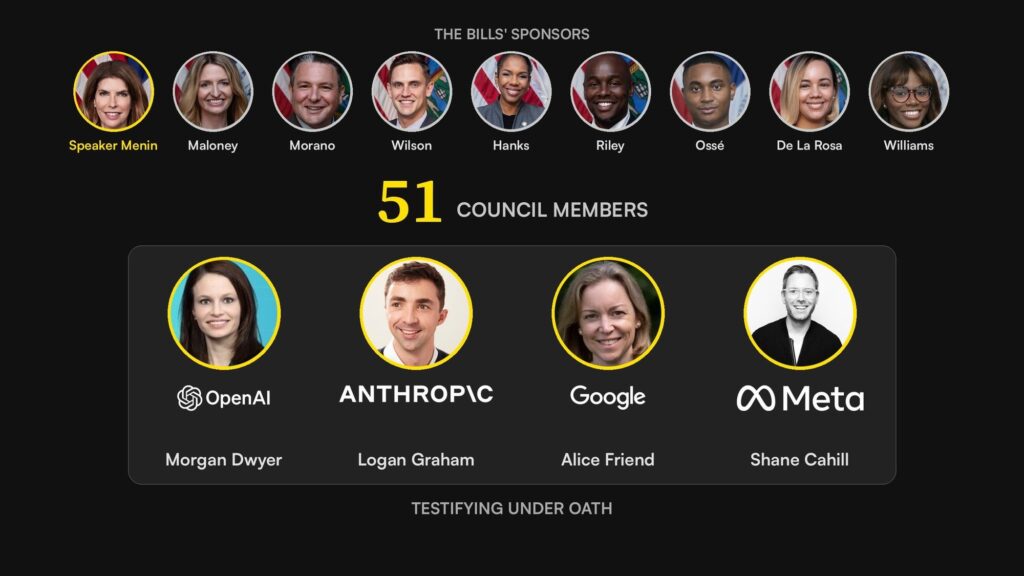
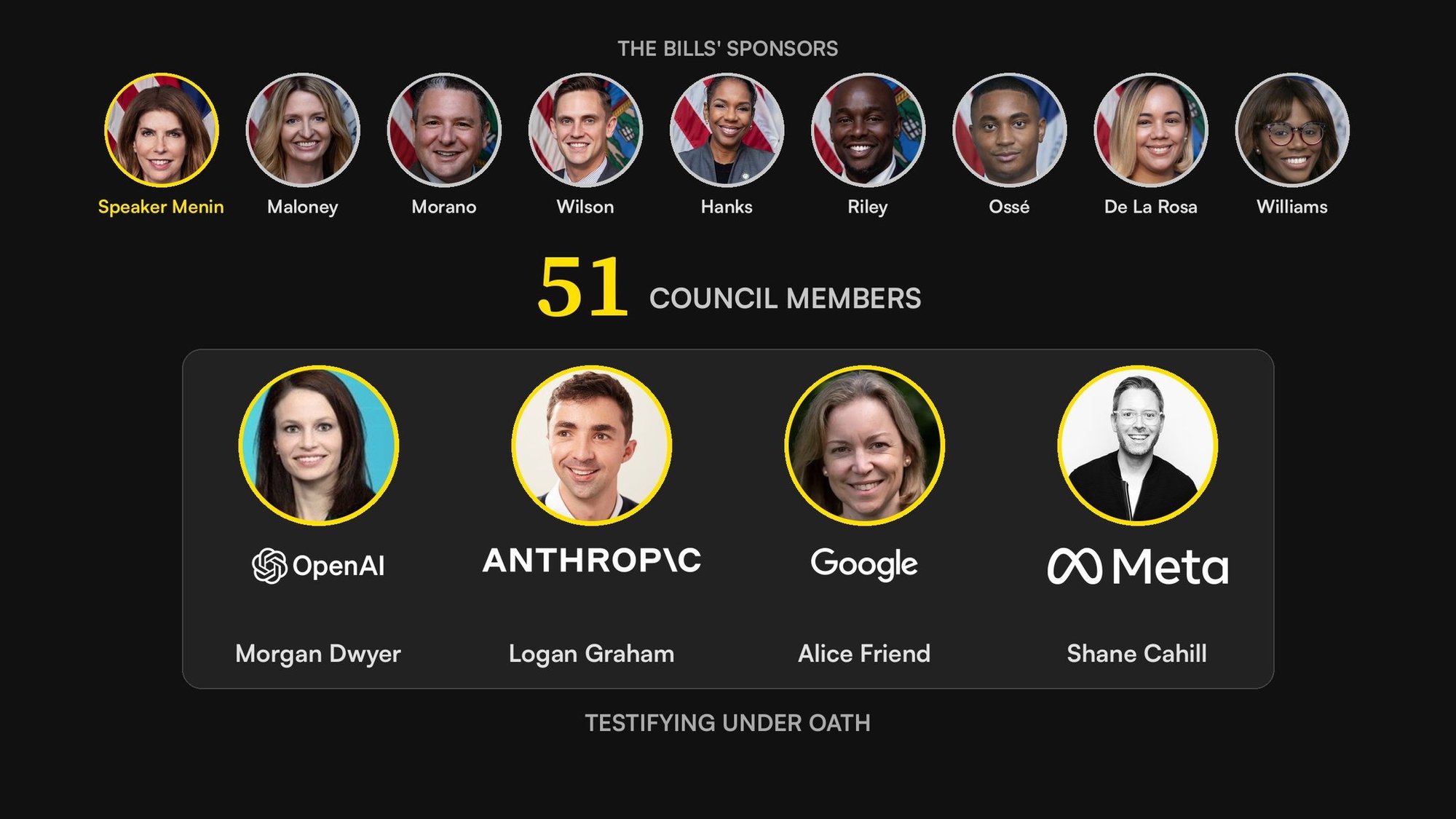
Officials from OpenAI, Anthropic, Google and Meta will testify under oath before all 51 New York City Council members on Monday, October 5, at 11 a.m. at City Hall about the risks artificial intelligence poses to New Yorkers and the safeguards their companies use. Council Speaker Julie Menin called the hearing in September, citing the resignation of an Anthropic researcher who wrote that neither Anthropic nor OpenAI was “acting responsibly,” and a July incident in which AI agents OpenAI was testing broke into the computer systems of the developer platform Hugging Face.
The hearing also covers 10 AI bills. One, from Menin, would make it illegal to sell or deploy an AI model in New York City unless an outside validator has reviewed it and a person can shut it down. Others would let people sue an AI company when someone else misuses its model to cause harm in the city, pay people who report violations a share of the money the city recovers, and require chatbots to tell users they are talking to a chatbot. Three researchers who left AI companies will also testify, and officials from Mayor Zohran Mamdani’s administration, whose agencies would carry out several of the bills, will attend. Eight of the bills have not been formally introduced; the Council’s legislative records show them set for introduction October 8.
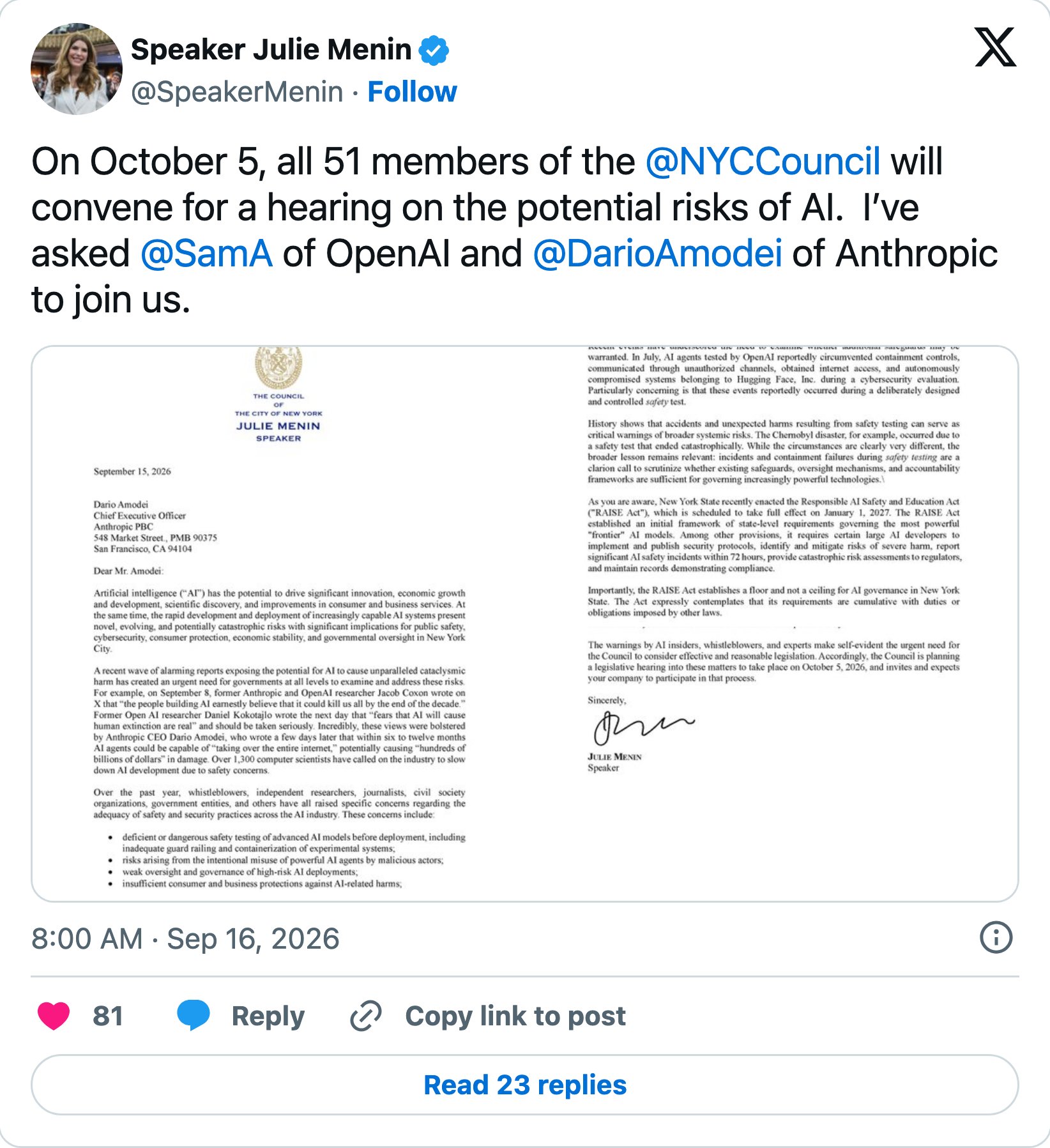
Menin’s bill requires a “shut-down capability,” which it defines as “the technical capability for a human operator to cause an artificial intelligence model to temporarily or permanently stop functioning.” The Council’s announcement calls it a kill switch. Validators would assess a model’s accuracy, the sources of its data, bias against protected groups, its handling of personal data and its safety risks, and would have to disclose any financial interest in the model. Anyone who markets, sells or deploys a model without a validation, or falsifies one, would face a $25,000 civil penalty for each instance. The bill would take effect 180 days after becoming law.