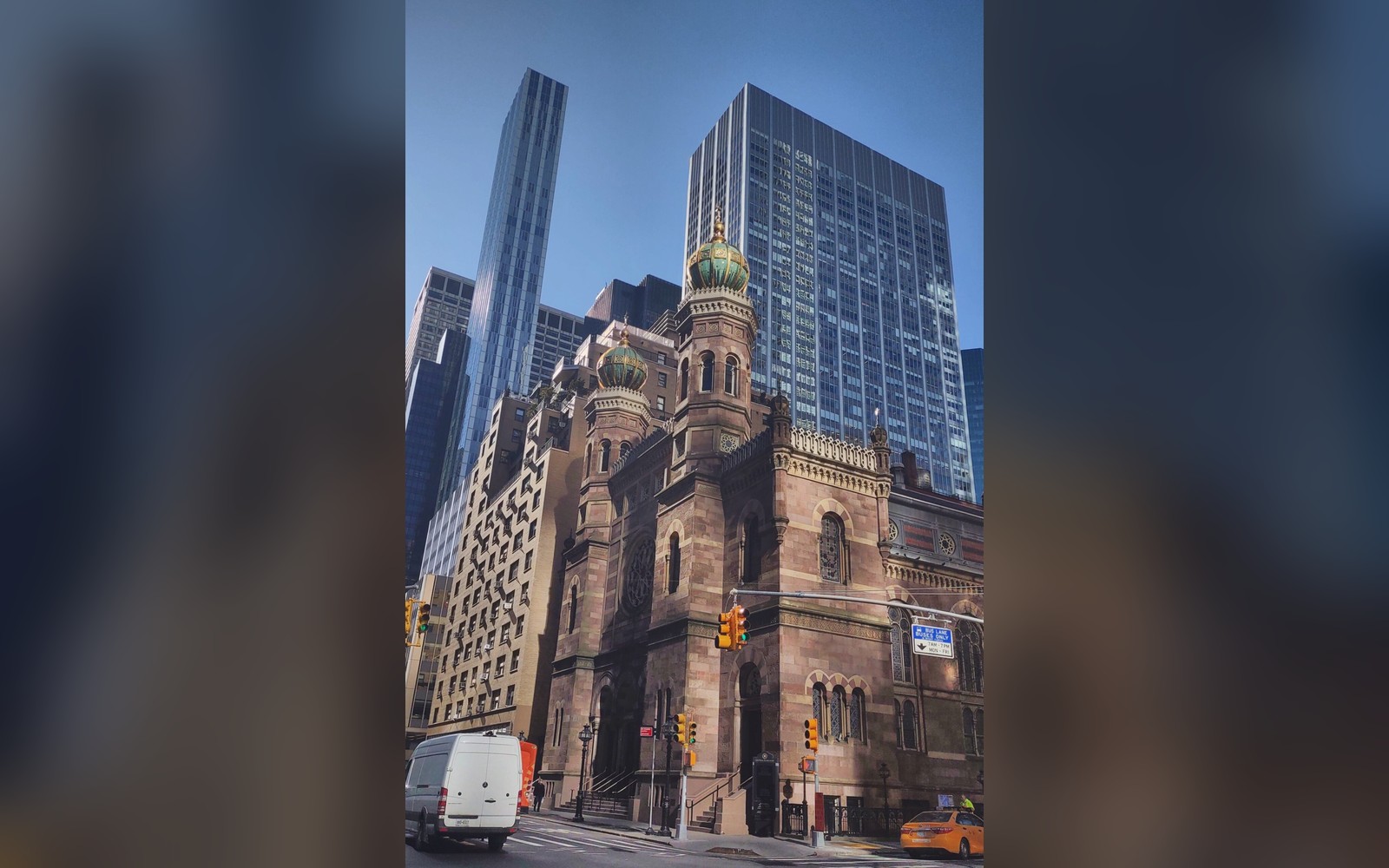
On May 15, federal prosecutors in Manhattan unsealed a complaint against a 32-year-old commander of Kataib Hezbollah, the Iran-backed Iraqi militia, who they say sent an undercover officer a photograph and a map pinpointing a prominent New York synagogue, attached a document identifying its congregants as supporters of Israel’s right to exist, and then paid $3,000 in cryptocurrency to set the bombing in motion, as Bushwick Daily reported. NYPD Commissioner Jessica Tisch said the plot was aimed at “the heart of our Jewish community.”
That $3,000 plot is now the anchor of a much larger fight in Washington. A coalition led by the American Jewish Committee has written to congressional leaders urging an expansion of the federal Nonprofit Security Grant Program to “up to $1 billion,” according to Jewish Insider. The coalition’s letter describes “an unprecedented and escalating threat environment facing religious communities and institutions across the United States” and argues the threat “is not abstract; it is very real and felt by the communities we represent on a daily basis.”
In 2024, the program received 7,584 applications requesting roughly $973 million. The Department of Homeland Security could fund only $454.5 million of it, approving about 43 percent of applications, with Jewish institutions making up 37 percent of recipients. More than half the synagogues, mosques, churches, and community centers that applied were told no. The $1 billion ask matches what all 2024 applicants requested combined.
The grant program, which the Department of Homeland Security has run since 2005, pays nonprofits and houses of worship at high risk of attack for the unglamorous basics: reinforced doors, shatter-resistant glass, blast film, cameras, alarms, fencing, panic buttons, and active-shooter training, per FEMA. The coalition’s letter also calls for passage of the Pray Safe Act, a bipartisan bill that would create a centralized DHS clearinghouse giving houses of worship one place to find security guidance, training, and information about which grants they actually qualify for. Congregations currently navigate that maze alone, which the coalition says is part of why so many applications go unfunded.
The coalition is not the only pressure building on Congress. In March, 150 House members led by Representative Gabe Amo, a Rhode Island Democrat, and Representative Michael McCaul, a Texas Republican, signed their own letter pushing the same $1 billion figure for fiscal year 2027, also reported by Jewish Insider. “This is a response that’s proportional to the demand, and right now, we need to act swiftly,” Amo said. The program ran on $274.5 million in 2025 and a proposed $300 million in 2026, meaning the $1 billion target is more than three times the current funding level.
The Anti-Defamation League counted 9,354 antisemitic incidents across the United States in 2024, the highest in the 46 years it has tracked them, including 196 assaults and 2,606 acts of vandalism. New York City recorded 976 of those incidents, more than any other city in the country, with 157 targeting synagogues and Jewish institutions directly. Of the 576 hate crimes the NYPD tallied across the five boroughs in 2025, 330 were antisemitic, about 57 percent, even though Jewish New Yorkers are roughly 10 percent of the city’s population, the Jewish Chronicle reported. “Antisemitism continues to be the most persistent hate threat that we face,” Commissioner Tisch said.
Nine Jewish organizations signed the federal letter alongside the American Jewish Committee: the Anti-Defamation League, the Conference of Presidents of Major American Jewish Organizations, Hillel International, the JCC Association of North America, the Jewish Federations of North America, the Rabbinical Assembly, the Union for Reform Judaism, the Orthodox Union, and the United Synagogue of Conservative Judaism. They were joined by organizations representing Muslim, Lutheran, Greek Orthodox, Hindu, Evangelical, Seventh-day Adventist, Sikh, and Catholic communities.
City Hall has been moving on a parallel track. In May, Mayor Zohran Mamdani announced a roughly $26 million expansion of the city’s Office for the Prevention of Hate Crimes, a near nine-fold jump from its previous budget, the Forward reported. “Too often, the only response offered to a hate crime is exactly that, it’s a response,” Mamdani said. “Today we want to also do the work of preventing those hate crimes.”
The $1 billion fight in Congress will not resolve before the next budget cycle. But there is state money available right now. New York State’s Securing Communities Against Hate Crimes program has up to $70 million open, with individual grants as large as $250,000 for security cameras, lighting, locks, training, and cybersecurity. Brooklyn synagogues, mosques, churches, community centers, and cultural nonprofits are all eligible. The application deadline is noon on July 8, through the Division of Criminal Justice Services.
Featured image: Courtesy bushwickdaily.com