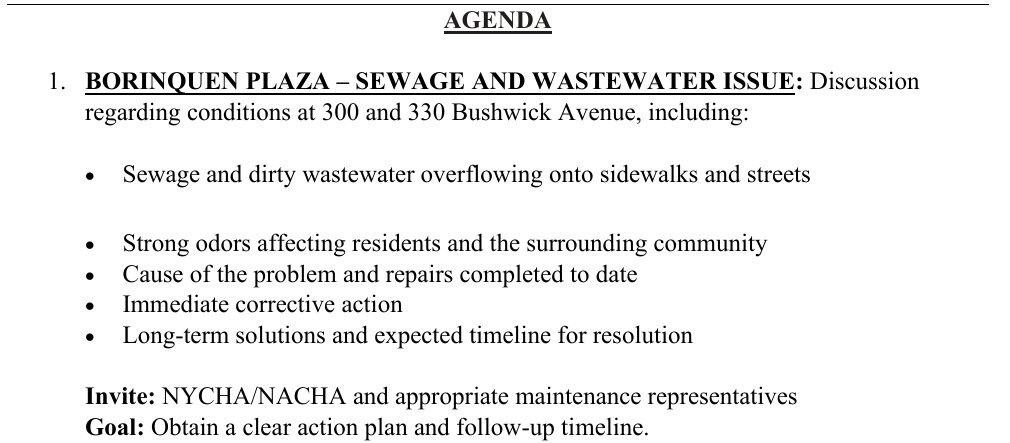
Raw sewage and dirty wastewater keep spilling onto the sidewalks and streets outside Borinquen Plaza, a New York City Housing Authority complex in Williamsburg that is home to nearly 2,000 people, where sewage has been backing up for more than a decade. 311 has logged more sewer and sewage complaints there this year than in any year since at least 2010. Brooklyn Community Board 1’s housing committee has invited NYCHA to discuss the overflows at 300 and 330 Bushwick Avenue on Tuesday, October 6, at 6 p.m. at the board’s district office, 435 Graham Avenue at Frost Street, with the goal of obtaining a clear action plan and follow-up timeline.



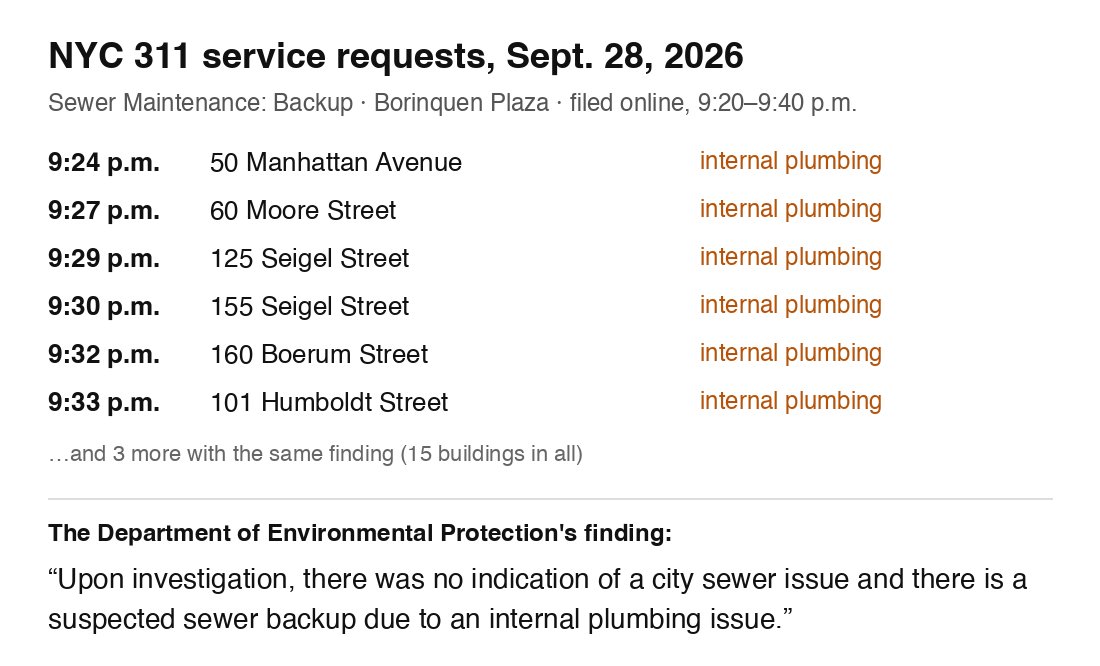
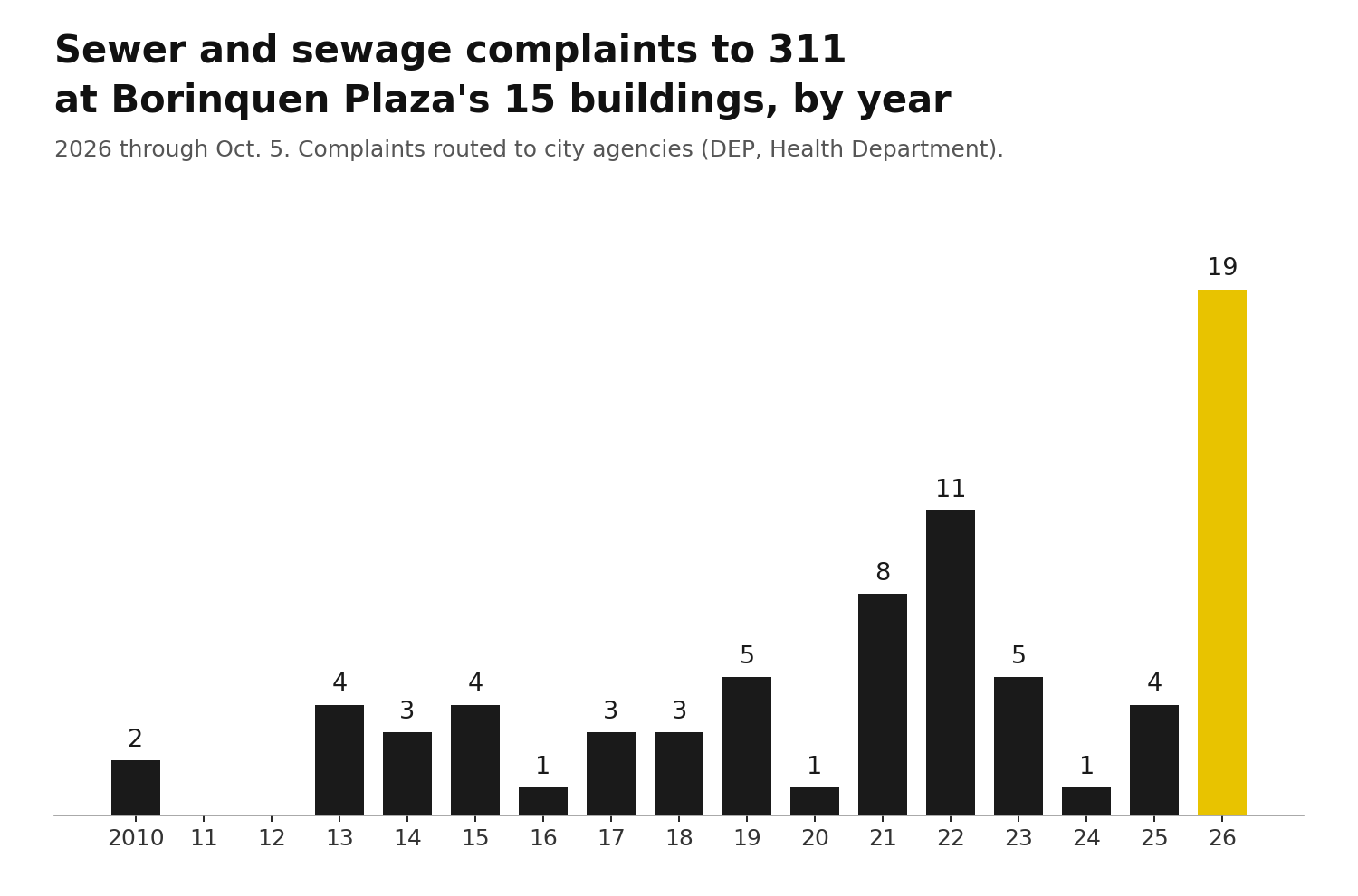
311 has logged sewer-backup or overflow complaints at the development’s buildings in every year but one since 2013. On the night of September 28, it received sewer-backup complaints for all 15 Borinquen Plaza buildings within 20 minutes. On nine of them, the city Department of Environmental Protection, which runs the sewer system, wrote that “there was no indication of a city sewer issue and there is a suspected sewer backup due to an internal plumbing issue,” meaning a problem in the buildings’ own pipes, which NYCHA maintains. The department had made the same finding on sewer-backup complaints at the development five times before, as far back as 2013.
Tenant leaders have complained to NYCHA about sewage backing up at the development since at least 2020, The City Reporter and CBS New York reported in 2023. In May 2023, NYCHA spokesperson Michael Horgan said a cracked sewage line at 300 Bushwick Avenue had been fixed and that repairs would continue as more problems were found, The City Reporter reported. NYCHA’s 2021 climate change adaptation plan rated both Borinquen Plaza developments at high risk of stormwater flooding, but Horgan said there was no funding for stormwater upgrades there and that NYCHA was seeking more local and federal money. The authority estimated then that it needed up to $68.8 billion over the next decade to repair its buildings citywide, The City Reporter reported. That month, NYCHA told CBS New York that its staff and plumbing vendor had found collapsed sewage pipes at the development. In June 2024, NYCHA told CBS New York that work had been completed at two of six affected buildings and that a third was nearing completion. That August, the authority said long-term repairs to Borinquen Plaza II’s plumbing system were being made. Two years later, sewage is still overflowing at 300 and 330 Bushwick Avenue, and 311 has logged 19 sewer and sewage complaints at the development this year.
The committee has also invited maintenance representatives, and the discussion will cover the strong odors affecting residents and the surrounding community, the cause of the problem, the repairs completed to date, immediate corrective action, and long-term solutions with an expected timeline. The meeting is being held at the request of the Housing and Public Housing Committee, which is chaired by Rabbi David Niederman.
Since 2021, 311 has logged 48 sewer- and sewage-related complaints at the development’s 15 buildings, 19 of them this year. 311 sends those complaints to city agencies such as the Department of Environmental Protection and the Health Department. None of the 311 complaints filed for the buildings since 2020 went to NYCHA; complaints tenants make directly to NYCHA about conditions inside their apartments do not appear in 311 data.


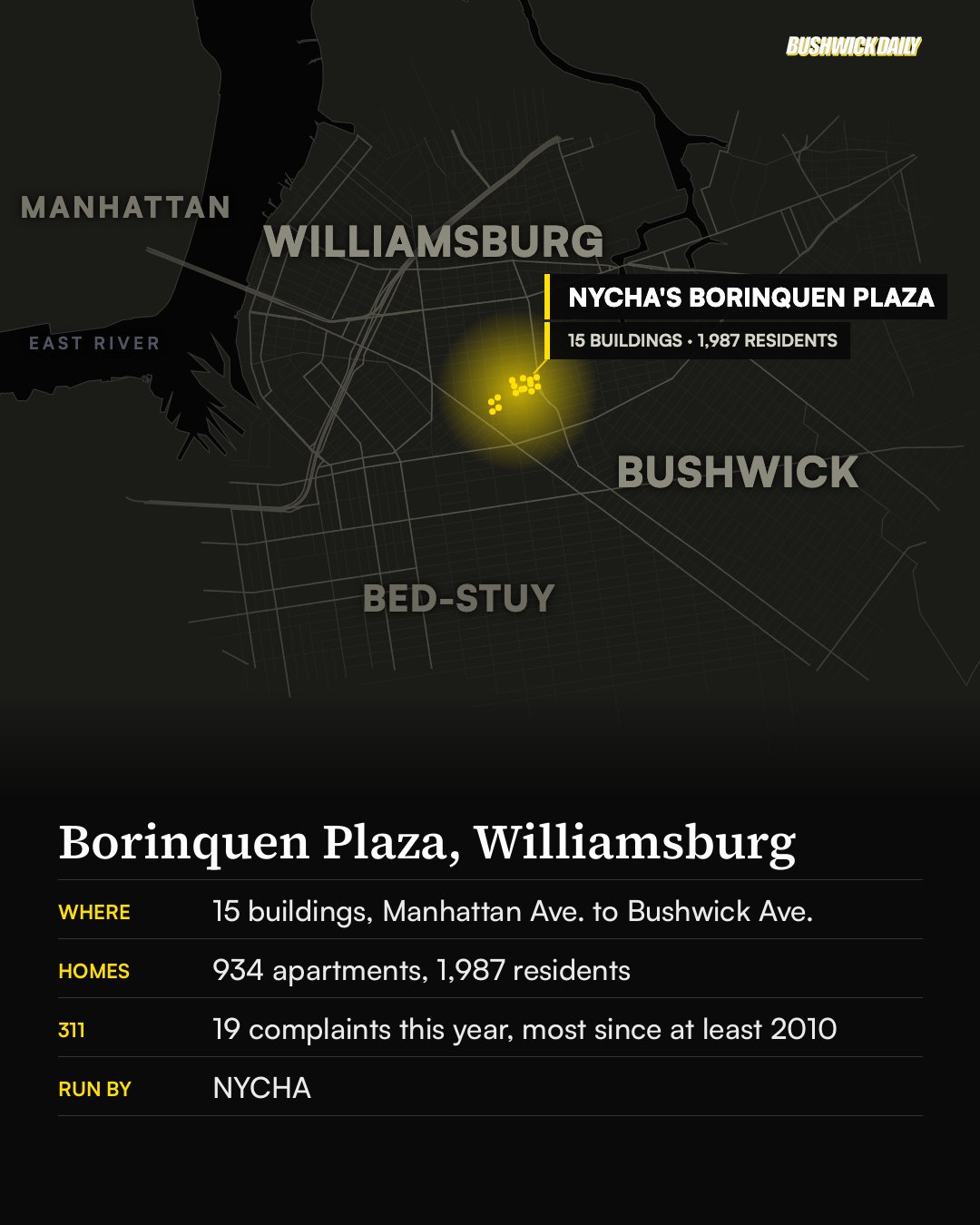
Borinquen Plaza I and II, completed in 1975, have 934 apartments and 1,987 residents in 15 seven-story buildings. As of January 2025, NYCHA ran both developments itself, with no private management company. 300 and 330 Bushwick Avenue are part of Borinquen Plaza II.
Weeks after a gas leak and explosion on February 18, 330 Bushwick Avenue and 101 Humboldt Street were still without gas, NYCHA Executive Vice President Brian Honan told Community Board 1. In April, NYCHA told the board that two buildings still lacked cooking gas and that residents had been given hot plates and slow cookers.
The development is in City Council District 34, represented by Jennifer Gutiérrez; Assembly District 53, represented by Maritza Davila; and State Senate District 18, represented by Julia Salazar.
Tuesday’s meeting will also follow up on concerns raised by the Williamsburg Housing Tenant Association, including previously reported tenant concerns, unresolved maintenance or building issues, new concerns affecting residents, and matters that need additional assistance or escalation. The committee will again invite seven affordable housing organizations and property managers that could not attend its previous meeting: Southside United HDFC, known as Los Sures; UJO; North Brooklyn Development Corporation; Hudson Companies; Halcyon Management Group; Park Tower Group; and Two Trees Management. It will ask them for updates on current housing and tenant concerns, occupied and vacant units, maintenance and building conditions, open violations and compliance issues, current or proposed affordable housing projects, and financial or operational challenges affecting their services.
Participating housing organizations will also give brief updates on maintenance, staffing, tenant concerns and building conditions, vacant units and the reasons for them, affordable housing development, open violations and outstanding repairs, and budget challenges affecting maintenance and operations. The committee then plans to review action items, identify the agencies or organizations responsible, set follow-up dates and confirm which matters need further committee review.
Nine members make a quorum for the committee. Brooklyn Community Board 1, which covers Williamsburg and Greenpoint, is chaired by Dealice Fuller, and Johana Pulgarin is its district manager.
Meeting notices are posted on Brooklyn Community Board 1’s agendas page. Requests for accommodations, including sign language interpretation, go to the board at (718) 389-0009, which asks for at least five business days’ notice.
Featured image: Wil540 art via Wikimedia Commons, CC BY-SA 4.0, modified