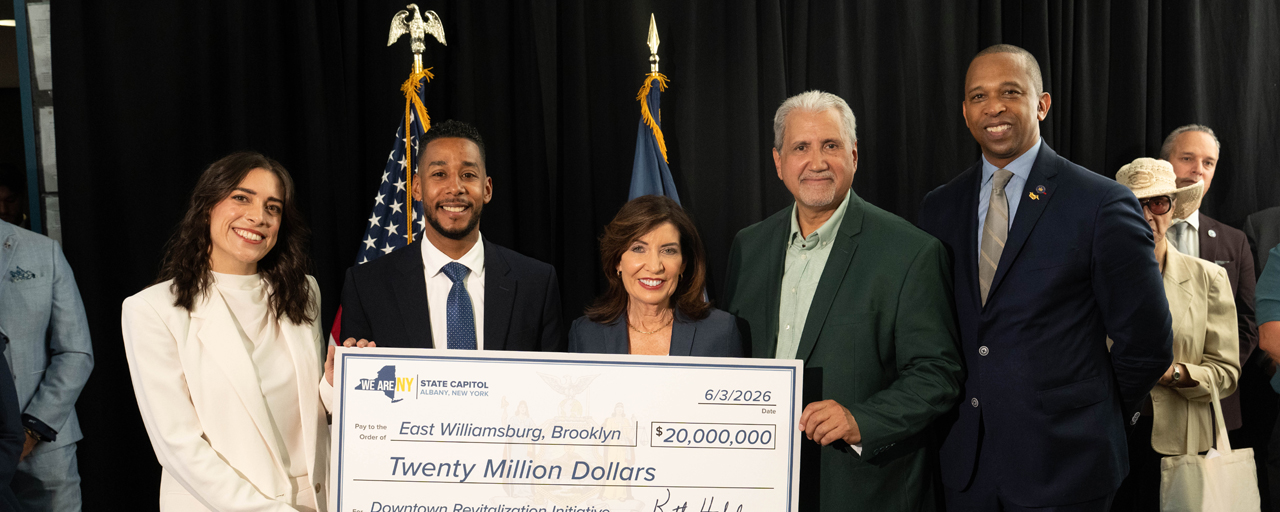
East Williamsburg just landed a rare windfall. On June 3, Governor Kathy Hochul named the neighborhood the New York City winner of the ninth round of the Downtown Revitalization Initiative and the fourth round of NY Forward, a combined $20 million award. There is a catch, and it is bigger than the check. The money does not get spent yet, it comes with strings tied to housing, and it lands on an industrial neighborhood that does not obviously have a ‘downtown’ to revitalize in the first place.

The award is not a blank check for $20 million in shovels. It is a planning prize. East Williamsburg now has to assemble a Local Planning Committee of community leaders and stakeholders and spend the coming months writing a Strategic Investment Plan that decides which projects the grant actually pays for. The DRI, created in 2016, calls this its plan-then-act model. Every one of the state’s 10 economic-development regions won the same $20 million this round, $200 million in all, and the program says it has handed out $1.4 billion since it began.
The strings are the point. To be eligible at all, a locality has to be certified under Hochul’s Pro-Housing Communities Program, the state’s carrot for places that agree to build. More than 420 communities have signed on, and the program dangles access to up to $750 million in discretionary funding. Hochul made the housing expectation explicit: the $20 million, she said, “will help to build more affordable housing in the neighborhood and bolster the community’s local economy for generations to come.” Statewide, the DRI says it has created more than 5,000 apartments, about 40 percent of them affordable or workforce units.
The bid came from the ground up. The Grand Street BID co-led the application with the Graham Avenue BID and Brooklyn Borough President Antonio Reynoso’s office, pitching a neighborhood of roughly 62,000 people, two business districts, and a mix of family-owned restaurants and small manufacturers. “East Williamsburg is a neighborhood that embodies the ideals that make New York great,” Hochul said, “from family-owned restaurants to small businesses that light up the community.”
Here is where it gets complicated. East Williamsburg is, at its core, an industrial neighborhood, a corridor of warehouses, small manufacturers and the businesses that grew up around them. A ‘downtown revitalization’ grant whose central string is a promise to build housing is an awkward fit for a place built on making things, and how the plan handles that tension is the real story under the celebration. Even the people accepting the award named a version of the risk out loud. Francesca Fernandez Bruce, who runs the Grand Street BID, said her neighbors had shown up “through the hard times and underinvestment,” and framed the goal as making sure “revitalization benefits those who have built and sustained this community,” not just whoever arrives next. Whether $20 million, spent on a plan written over the next year, actually does that is the entire question.
The Strategic Investment Plan is the part still open, and the part residents can actually shape. The Local Planning Committee process runs on public meetings where neighbors weigh in on which projects get funded: the affordable housing, the streetscape, the small-business help, or something else entirely. The Grand Street BID at grandstreetbk.org and the state’s Downtown Revitalization Initiative program page are where the committee roster and meeting schedule will be posted as the process starts. If you live or run a business in East Williamsburg, this is the uncommon moment when the spending is decided before it happens, not after.
Featured image: Office of Governor Kathy Hochul