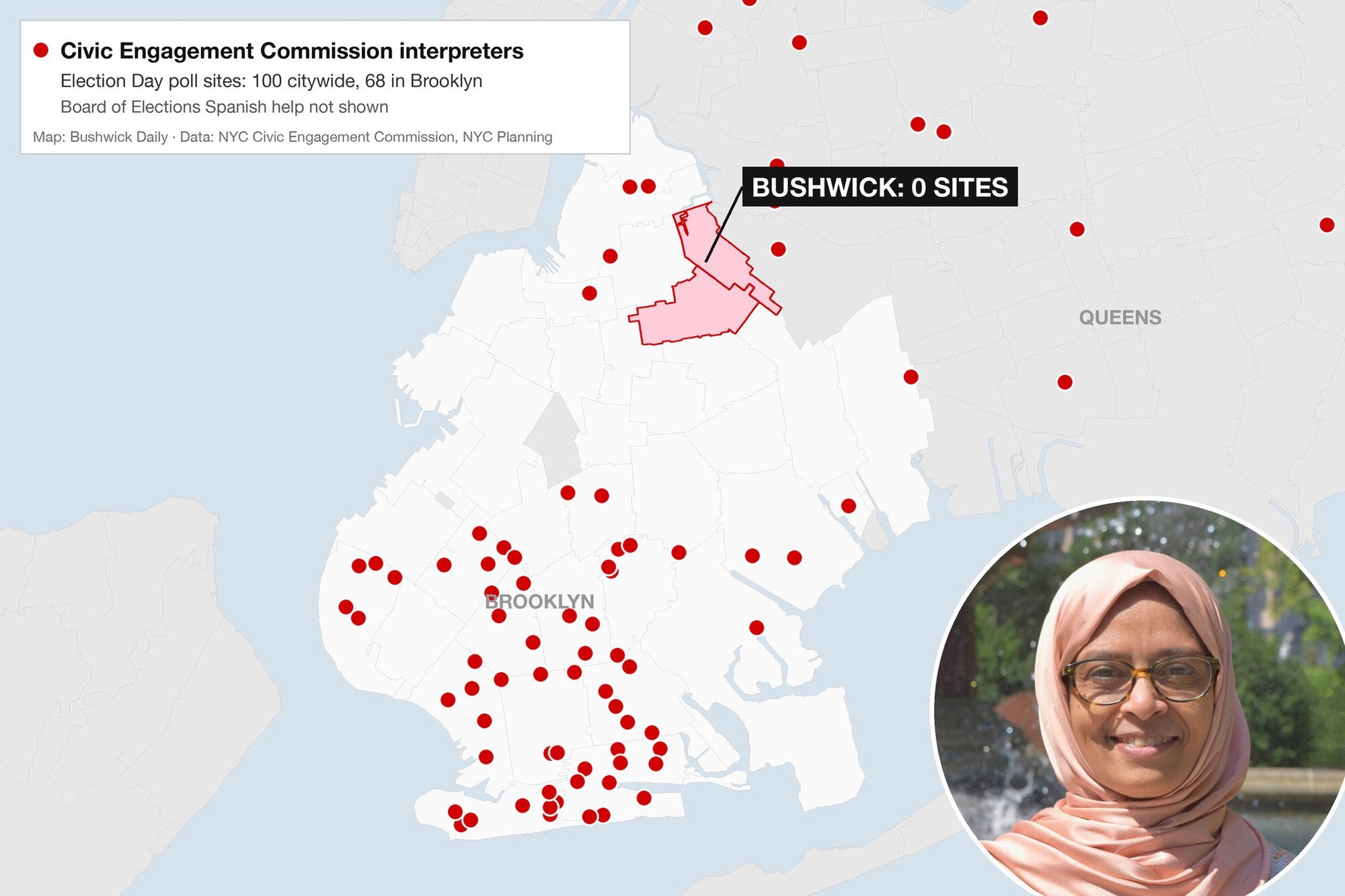
According to records published by the city's Civic Engagement Commission, none of the 100 poll sites where New York City is stationing its own interpreters on Election Day Tuesday are in Bushwick's 11237 or 11221 ZIP codes, though 68 are elsewhere in Brooklyn.
The commission's interpreters cover 13 languages but not Spanish, which the Board of Elections provides at poll sites in every borough. Last November, 1,033 of the 1,559 voters who used the commission's interpreters spoke Russian, according to the commission's annual report.
Nearby commission sites include IS 71 Juan Morel Campos at 215 Heyward Street, which offers Yiddish, and IS 93 at 66-56 Forest Avenue in Ridgewood, which offers Polish. Last November those two sites’ interpreters assisted one voter and five voters, respectively, according to the commission.
The 100 sites are up from 88 last November. For the first time in a general election, the commission’s interpreters will offer Greek and Albanian, which the commission added after a state voting rights law shifted some Chinese, Urdu and Bengali interpretation to the Board of Elections, according to the commission’s 2026 annual report.
The commission lists 13 languages, counting Cantonese and Mandarin Chinese as one: Albanian, Arabic, Bengali, Chinese, French, Greek, Haitian Creole, Italian, Korean, Polish, Russian, Urdu and Yiddish. It also staffed 50 sites during the final two days of early voting, October 31 and November 1.
Last November, 1,559 voters used the commission’s interpreters, nearly double the number in the 2021 general election, according to the commission’s annual report. The busiest election in the program’s history was the 2024 presidential race, when 2,237 voters received help, the commission reported. When the commission designed the program in 2020, it estimated that running it at 100 poll sites could serve as many as 69,940 voters, Gotham Gazette reported at the time.



The city budgeted $1 million for the commission’s poll site interpretation program in each of the past two fiscal years, according to city budget data published on Checkbook NYC. The interpreters are supplied by the contractor TheBigWord under a $2.6 million city contract that runs through September 2027, city records show. The commission wrote in its latest annual report that “additional resources are needed” and that elected officials and members of the public keep asking it to add languages and poll sites.
Language access at the polls is governed by overlapping federal, state and city rules. The commission’s interpretation program supplements, and by law cannot duplicate, the services the New York City Board of Elections already provides. About 60 percent of Board of Elections poll sites offer help in a language covered under the federal or state Voting Rights Act, Vincent Ignizio, the board’s deputy executive director, told City Limits. The board provides interpreters in Spanish and Chinese in Manhattan and Staten Island; Spanish, Chinese, Korean, Bengali and Urdu in Brooklyn; Spanish, Chinese, Korean, Bengali, Tagalog, Hindi and Punjabi in Queens; and Spanish in the Bronx, according to City Limits.
New Yorkers also have the right to bring their own interpreter into the voting booth. Voters whose language is not covered at their poll site may be assisted by a person of their choice, including a friend, family member or poll worker. The helper cannot be the voter’s employer, an agent of that employer, or an officer or agent of the voter’s union.
Dr. Sarah Sayeed, the commission’s chair, and Anila Cobo, director of its Voter Language Assistance Program, said they planned to operate at 100 unique polling places for the general election with a team of 240 interpreters, City Limits reported.
The city’s language assistance programs are aimed at a sizable population. A Campaign Finance Board report found that 16.4 percent of New York City citizens of voting age have limited English proficiency, a share that rises to 20.7 percent in Queens and 19.5 percent in the Bronx. New York City residents speak just over 700 languages, City Limits reported.
Voters created the Civic Engagement Commission through a 2018 ballot measure, and it began providing interpretation in 2020, offering 11 language groups through 2025. In 2019 the Board of Elections went to court to block interpreters placed by a city pilot program that preceded the commission’s, and lost, Gotham Gazette reported.
Murad Awawdeh, president and CEO of the New York Immigration Coalition, who was involved in creating the commission, told City Limits, “The CEC created the Voter Language Assistance Program to ensure that anyone who speaks the … top 14 languages in New York City had the support that they needed when they got to a polling site, to have someone translate for them and help them understand their ballot better.”
Poll sites are also equipped with tablets that voters can use to connect with a remote interpreter when an in-person interpreter is not available, Ignizio told City Limits. Voters who encounter problems at the polls can call 311, the Election Protection Hotline at 866-687-8683, or the state attorney general’s voter protection hotline at 866-390-2992. The commission’s map of serviced poll sites and the languages offered at each is posted on its Election Day services map.
Information about the program is posted on the commission’s Voter Language Access page.
Featured image: Map: Bushwick Daily; data: NYC Civic Engagement Commission, NYC Planning. Photo: NYC Civic Engagement Commission (circle). Composite by Bushwick Daily