New York City Mayor Zohran Mamdani and City Council Speaker Julie Menin reached a handshake deal on a $125.8 billion Fiscal Year 2027 budget on June 30. The plan expands rental assistance to tens of thousands of low-income New Yorkers and extends transit discounts to 340,000 more residents. A last-minute housing voucher dispute nearly sank the agreement, according to reporting by City Limits and City and State.
The Council passed the budget 45-6 later that evening, as amNewYork reported. Five Republicans and one Democrat (Bronx Council Member Althea Stevens) voted no. Stevens said in floor remarks that the budget did not fully meet the needs of her district, one of the city’s poorest.
The biggest fight in the final days was over CityFHEPS, the city’s rental voucher program for shelter residents. Mamdani had promised on the campaign trail to expand it, then reversed course after taking office, citing the program’s ballooning cost. The Council pushed for as much as $300 to $500 million in new voucher funding in the final stretch of negotiations; what they got was $175 million for FY27, with $125 million baselined starting in FY28, according to City Limits. Council Member Pierina Sanchez and the Progressive Caucus led the final negotiations, with some members saying they would vote against the budget without a satisfactory expansion, City and State reported. None ultimately voted no over the issue.
The new money does not go into CityFHEPS itself but creates a separate program. According to City Limits, the program will be administered by the Department of Housing Preservation and Development rather than the Department of Social Services, which runs the existing voucher program. CityFHEPS is an entitlement, meaning anyone who qualifies has a legal right to a voucher. The new program will be subject to annual appropriations, with a capped number of vouchers. City Hall estimated it would serve roughly 5,600 households, or 14,000 people. The Council put the figure at up to 9,600 households, or 30,000 people, according to City Limits. The deal also drops a lawsuit the Council had filed after the prior Adams administration refused to implement a 2023 CityFHEPS expansion.
Some New Yorkers previously shut out of CityFHEPS will qualify under the new program. City Limits reported that rent-stabilized tenants facing eviction and people staying in homeless shelters run by agencies other than the Department of Homeless Services will be eligible for the new vouchers, without work requirements. There were roughly 10,500 such individuals in April.
“We are expanding access to housing vouchers responsibly, delivering relief to tens of thousands of New Yorkers, and putting the City on a stronger path away from costly shelter reliance and toward permanent homes,” said Council Member Pierina Sanchez, who led negotiations on the voucher deal, in a statement quoted by City Limits.
The budget also expands Fair Fares, the discounted transit program, by $54 million, raising income eligibility from 150 percent to 200 percent of the federal poverty level. According to the mayor’s press office, an additional 340,000 residents will qualify, bringing total eligibility to about 1.3 million New Yorkers.
The final budget dropped Mamdani’s proposed NYPD expansion, according to City and State. His executive budget had included $70 million to add 580 uniformed officers, a pivot from his campaign pledge to keep headcount flat. Menin said she learned of the change the night before the handshake. “He called me late last night to tell me,” she told amNewYork. “It’s not a decision I agree with.” The department will stay at its authorized level of 35,000 officers. Menin said at a later press conference that she “strongly disagrees” with the decision.
The budget baselines funding for libraries, parks, cultural organizations, CUNY, and Fair Fares. These programs had faced annual uncertainty about renewal, according to the mayor’s press office. It sets aside $350 million for the city’s general reserve and allocates $34.2 million to build a public online portal for post-9/11 air quality and health documents, with an initial release scheduled before the 25th anniversary of the September 11 attacks.
Maria Odom, executive director of Advocates for Children of New York, praised the budget for continuing five education programs whose funding had been set to expire this week. The programs include mental health services at school and sensory support for students with disabilities. She also welcomed an additional $67.5 million investment in preschool special education, nearly doubling the $70 million baselined from the prior year. “This funding will help ensure more young children get the support they need to learn and grow, saving the City money in the long run,” Odom said in a statement.
Fiscal watchdogs were less satisfied. Andrew Rein, president of the Citizens Budget Commission, said in a statement quoted by amNewYork that “the gap is closed mainly with one shots, short-term savings, and cost shifts to future taxpayers, leaving the City to face a gaping hole next year and undue stress in the years after.” The City Reporter cited fiscal experts who expect the FY2028 budget to project a deficit of more than $7 billion.
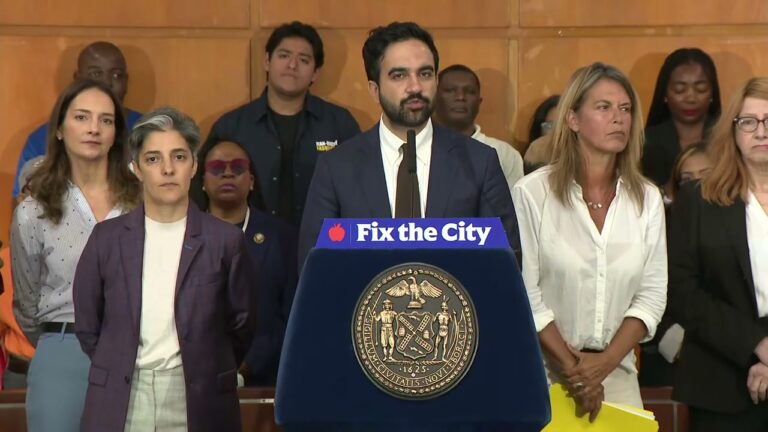
“We balanced this budget without resorting to austerity,” Mamdani said at the June 30 announcement, per the mayor’s press office. “We protected the services New Yorkers rely on, while restoring honesty to the City’s finances.”
Featured image: Courtesy advocatesforchildren.org