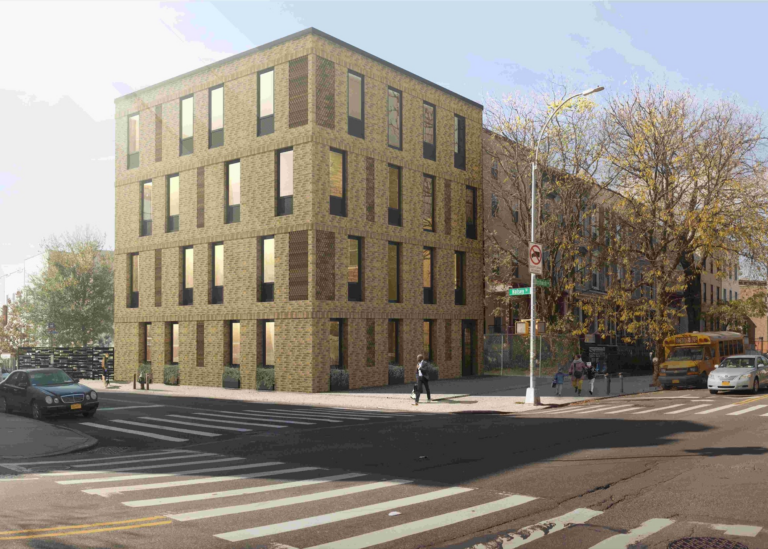
A long-fought Greenpoint high-rise on the waterfront cleared a major hurdle Thursday. On June 25, the City Council’s zoning subcommittee and its Land Use Committee both voted unanimously to approve Monitor Point, the three-tower development planned for an MTA-owned lot at 40 Quay Street, just north of Bushwick Inlet Park. The vote came after developer The Gotham Organization agreed, in last-minute negotiations, to nearly double the amount of affordable housing in the project.
The deal was first reported by Kirstyn Brendlen for Brooklyn Paper, in a version that also ran on Brownstoner.
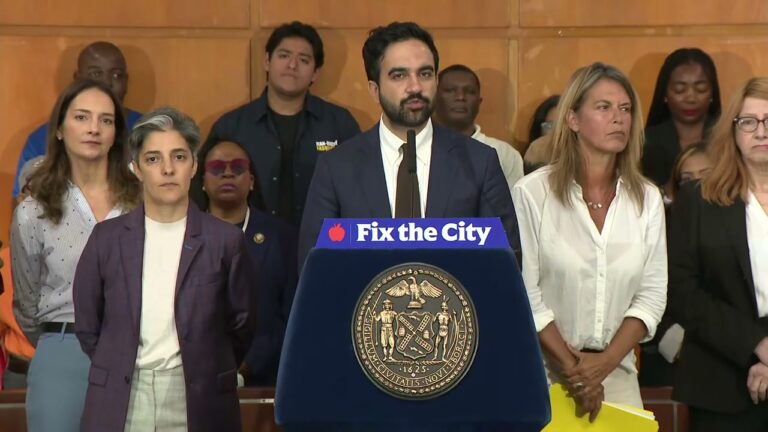
Council Member Lincoln Restler, whose district includes the site and whose vote effectively decides these Greenpoint rezonings, threw his support behind the project after the developer, the MTA and his office reached a final agreement he said landed “moments” before he walked into the hearing. Restler had spent weeks saying he would not approve Monitor Point unless it was majority affordable and came with an “ironclad” commitment to finishing the long-delayed Bushwick Inlet Park next door.
Gotham originally pitched 1,150 total apartments, 400 of them affordable at 40 to 80 percent of the Area Median Income. The approved project is bigger and deeper: 1,324 apartments total, with 662 of them, exactly half, permanently affordable and rent-stabilized. About half of that affordable share will be “deeply” affordable, Restler said. A family of three earning $76,350 a year, which is 50 percent of AMI, would pay $1,822 a month for a two-bedroom.
Another 172 units are set aside for “moderate income” households between 80 and 120 percent of AMI. In that band, a two-bedroom would run $2,916 to $4,374 a month for a family of three making $122,160 to $183,240. The remaining affordable apartments are reserved as senior housing, with one-bedrooms starting around $911. Market-rate units in the building are expected to start near $4,000 for studios and climb to $9,500 for three-bedrooms.
Restler emphasized that 110 of the units will be supportive housing. “That’s deeply affordable housing for formerly homeless individuals with on-site services to ensure that we are actually meeting the moment of our homelessness crisis,” he said.
Monitor Point is the product of an MTA plan to squeeze revenue out of the waterfront lot by leasing it to a developer who would also pay to move the agency’s existing vehicle wash facility off the site. Gotham is expected to pay the MTA about $39 million over the first 25 years of the lease, and will also fund the relocation of the MTA’s Emergency Response Unit, which currently occupies the footprint of the soon-to-be-built Box Street Park. The agency says it will use the lease money to make the Nassau Avenue G train station ADA accessible.
“Transit-oriented development like Monitor Point is a win-win for our riders and our neighborhoods,” said Jamie Torres-Springer, president of MTA Construction and Development, in a statement. He said the deal would deliver affordable housing, open space and a restored waterfront “while advancing our core transit mission through improved facilities and capital funding.”
Beyond the apartments, Gotham has committed to a publicly accessible waterfront esplanade, shoreline resiliency work, discounted space for local nonprofits and a new permanent home for the Greenpoint Monitor Museum. The developer has also said it will donate $300,000 a year toward maintaining Bushwick Inlet Park.
That park has been central to the dispute. The city promised the 28-acre Bushwick Inlet Park as part of the 2005 Greenpoint-Williamsburg rezoning. More than 20 years later it is only partially built, with two of its largest parcels still barren, industrial and stuck in remediation disputes between fossil fuel companies. Monitor Point sits directly north of the park’s newest finished section, the Motiva parcel, which opened to the public in April. Restler said Mayor Zohran Mamdani, who toured the unfinished sections with him earlier this year, “told me that he is committed to fulfilling the promise of this park and completing Bushwick Inlet Park.”
Restler framed his yes vote as the end of a five-year standoff. He said he first heard about the project shortly after winning the 2021 Democratic primary in Council District 33, and recalled “screaming on the phone” to an MTA representative about it. “I thought this project was a total nonstarter, and it’s come an extraordinarily long way,” he said. “I’ve been clear over these five years that any development of this publicly owned land must be primarily in the public interest.” He has pointed out that just 16 percent of the roughly 30,000 units built in Williamsburg and Greenpoint are affordable, and argued that public land is where the city has to do better.
Some advocates still opposed the project. Advocates with Save The Inlet, who opposed the project, said they welcomed the added affordable housing but still did not want to see it approved. They note that Monitor Point sits within a FEMA Special Flood Hazard zone and a critical migratory bird corridor, and have long worried that the towers will overshadow the park and turn the small inlet section that borders the site into a “front yard” for a luxury development rather than a public space.
“Bushwick Inlet was always meant to be a place where nature, recreation, and resilience could thrive together,” Save The Inlet said in a statement. “It should not become another example of public waterfront sacrificed to oversized private development.”
Gotham is looking ahead to the full Council vote. “We look forward to the full City Council vote and continuing to work with the community as Monitor Point moves closer to reality on a true public-private partnership,” a spokesperson said, crediting the Mamdani administration, Council Speaker Julie Menin, Restler, HPD, the MTA, the governor’s office and community partners. With Restler on board, the project is expected to pass the full City Council without trouble.
Featured image: Bushwick Daily archive